(formerly CHEMICAL WASTE MANAGEMENT, INC.)
(X*TRAX™ Thermal Desorption)
TECHNOLOGY DESCRIPTION:
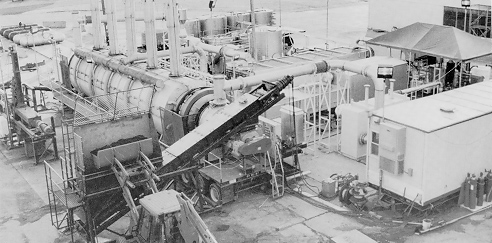
The X*TRAX™ technology is a patented thermal desorption process that removes organic contaminants from soils, sludges, and other solid media (see photograph below). X*TRAX™ is not, however, an incinerator or a pyrolysis system. Chemical oxidation and reactions are discouraged by maintaining an inert environment and low treatment temperatures. Combustion by-products are not formed in X*TRAX™, as neither a flame nor combustion gases are present in the desorption chamber.
Full-Scale X*TRAX™ System
The organic contaminants are removed as a condensed liquid, which is characterized by a high heat rating. This liquid may then be destroyed in a permitted incinerator or used as a supplemental fuel. Low operating temperatures of 400 to 1,200 °F and low gas flow rates optimize treatment of contaminated media.
An externally fired rotary dryer volatilizes the water and organic contaminants from the contaminated media into an inert carrier gas stream. The inert nitrogen carrier gas transports the organic contaminants and water vapor out of the dryer. The carrier gas flows through a duct to the gas treatment system, where organic vapors, water vapors, and dust particles are removed and recovered. The gas first passes through a high-energy scrubber, which removes dust particles and 10 to 30 percent of the organic contaminants. The gas then passes through two condensers in series, where it is cooled to less than 40 °F.
Most of the carrier gas is reheated and recycled to the dryer. About 5 to 10 percent of the gas is separated from the main stream, passed through a particulate filter and a carbon adsorption system, and then discharged to the atmosphere. This discharge allows addition of make-up nitrogen to the system to keep oxygen concentrations below 4 percent (typically below 1 percent). The discharge also helps maintain a small negative pressure within the system and prevents potentially contaminated gases from leaking. The volume of gas released from this process vent is approximately 700 times less than from an equivalent capacity incinerator.
WASTE APPLICABILITY:
The X*TRAX™ process has been used to treat solids contaminated with the following wastes: polychlorinated biphenyls (PCB); halogenated and nonhalogenated solvents; semivolatile organic compounds, including polynuclear aromatic hydrocarbons, pesticides, and herbicides; fuel oils; benzene, toluene, ethylbenzene, and xylene; and mercury.
STATUS:
This technology was accepted into the SITE Demonstration Program in 1989. The demonstration was conducted in May 1992 at the Re-Solve, Inc., Superfund site in Massachusetts. After the demonstration, the full-scale X*TRAX™ system, Model 200, remediated 50,000 tons of PCB-contaminated soil at the site. The Demonstration Bulletin (EPA/540/MR-93/502), which details results from the demonstration, is available from EPA.
The full-scale system, Model 200, is presently operating at the Sangamo-Weston Superfund site in South Carolina. More than 45,000 tons of PCB-contaminated soil, clay, and sludge have been thermally treated at this site. Feed material with PCB concentrations of more than 8,800 milligrams per kilogram (mg/kg) has been successfully treated to produce (discharge) PCB levels of less than 2 mg/kg. PCB removal efficiency was demonstrated to be greater than 99.97 percent.
Laboratory-, pilot-, and full-scale X*TRAX™ systems are available. Two laboratory-scale, continuous pilot systems are available for treatability studies. More than 108 tests have been completed since January 1988.
DEMONSTRATION RESULTS:
During the SITE demonstration, X*TRAX™ removed PCBs from feed soil and met the site-specific treatment standard of 25 mg/kg for treated soils. PCB concentrations in all treated soil samples were less than 1.0 mg/kg and were reduced from an average of 247 mg/kg in feed soil to an average of 0.13 mg/kg in treated soil. The average PCB removal efficiency was 99.95 percent.
Polychlorinated dibenzo-p-dioxins and polychlorinated dibenzofurans were not formed within the X*TRAX™ system. Organic air emissions from the X*TRAX™ process vent were negligible (less than 1 gram per day). PCBs were not detected in vent gases.
X*TRAX™ removed other organic contaminants from feed soil. Concentrations of tetrachloroethene, total recoverable petroleum hydrocarbons, and oil and grease were reduced to below detectable levels in treated soil. Metals concentrations and soil physical properties were not altered by the X*TRAX™ system.
FOR FURTHER INFORMATION:
EPA PROJECT MANAGER:
Paul dePercin
U.S. EPA
National Risk Management Research Laboratory
26 West Martin Luther King Drive
Cincinnati, OH 45268
513-569-7797
Fax: 513-569-7105
E-Mail:
dePercin.Paul@epamail.epa.gov
TECHNOLOGY DEVELOPER CONTACT:
Chetan Trivedi
OHM Remediation Services Corp.
100 West 22nd Street, Suite 101
Lombard, IL 60148
630-261-3958
Fax: 630-261-3969