










SRP Progress in Research Summer 2026 Webinar Series: Session II
Live Webinar: Thursday, July 16, 2026, 3:00PM-5:00PM EDT (19:00-21:00 UTC)
Sponsored by: The NIEHS Superfund Research Program (SRP)

This Progress in Research webinar series, hosted by the National Institute of Environmental Health Sciences (NIEHS) Superfund Research Program (SRP), showcases research from 6 schools funded by SRP in 2025. These awards were made as part of the P42 grant solicitation RFA-ES-20-014. In the two-part series, awardees will highlight their research projects, accomplishments, and next steps. The newly funded centers, including Baylor College of Medicine, University of Arizona, and University of Iowa, are bringing fresh ideas and approaches to tackle complex problems related to hazardous substances.
The Baylor College of Medicine (BCM) SRP Center investigates whether the maternal exposure to polycyclic aromatic hydrocarbons (PAHs) emanating from superfund sites, as well as other environmental chemicals, increases the risk of preterm births (PTBs) and augments major neonatal morbidities such as bronchopulmonary dysplasia. The BCM SRP Center wants to determine the mechanisms by which PAHs contribute to PTBs and understand the factors that could be targets for interventions to prevent and reduce the health burden associated with PAHs present in Superfund sites.
The University of Arizona SRP Center works to address the unique human health risks encountered in the U.S. Southwest, a region with a rich history of metal mining and generation of mine wastes. Their overall goal is to construct a mechanistic model of how chronic exposure to mining-impacted dust that is co-contaminated with metal(loid)s and fungal spores contributes to the development of nonmalignant lung diseases. They aim to implement this model to predict exposures and associated health outcomes, to inform public health prevention in communities neighboring mine waste sites, and design remediation-based interventions to exposure.
The University of Iowa SRP Center focuses its research on polychlorinated biphenyls (PCBs). The center studies PCBs in the air, particularly in schools and those emitted from contaminated soils and water of Superfund sites. Researchers examine the health impacts of inhaled PCBs, particularly on adolescents, with a focus on neurodevelopmental and metabolic effects. The University of Iowa SRP Center’s long-term goal is to develop recommendations to prevent and/or limit human exposure to airborne PCBs and to improve the health and well-being of the population.
To learn about and register for the other session in this webinar series, please see the SRP website.
To be inserted
Moderator:
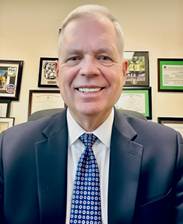 Ray Ledbetter, U.S. EPA Office of Superfund and Emergency Management (OSEM) (Ledbetter.Ray@epa.gov or 202-564-8564)
Ray Ledbetter brings over three decades of environmental expertise to his work, with a federal career spanning more than 17 years at the U.S. Environmental Protection Agency. Currently serving as an Emergency Management Specialist in OSEM's Workforce Readiness and Training Branch, he leads the planning and delivery of training programs for On-Scene Coordinators and Remedial Project Managers; including OSC Readiness, NARPM, the CERCLA Education Center, and the CLU-IN platform. Throughout his EPA tenure, Ray has held notable roles including Acting Special Assistant to the OEM Director, Acting Associate Director, and Physical Scientist with the Environmental Response Team. Beyond his federal service, he has been appointed three times by U.S. Presidents to the Selective Service System and volunteers as a Hazmat Safety Officer with the Baker Heights Volunteer Fire Department in West Virginia. Ray holds both an M.S. and B.S. in Geology and is licensed as a professional geologist in multiple states. He is a Certified Professional Geologist through the American Institute of Professional Geologists and holds the dual distinction of Chartered Geologist and Fellow of the Geological Society of London.
- These materials will be available by Thursday, July 16, 2026
Webinar Slides and References:
- These materials will be available by Thursday, July 16, 2026
Additional Resources:
- These materials will be available by Thursday, July 16, 2026
The feedback form for this webinar will be available starting on Thursday, July 16, 2026.
Help & FAQs
- Frequently Asked Questions
- Content Questions?
Call Maura Cavagnaro at 202-715-3859 or maura.cavagnaro@nih.gov - Technical Problems?
Leave us a comment - Cancel Your Registration
- My Participation Records
- CEU Credits and PDHs
Zoom Resources
Before Webinar Day
This seminar will be delivered through Zoom. Participants are encouraged to update to the latest version of the Zoom application for the best experience.
If you are unable to install the Zoom application, most functions will be available if you join just using a modern web browser such as Chrome, Edge or Firefox. We strongly encourage you to run the Zoom Meeting Test prior to attending this webinar. Technical support on the day of the webinar will be very limited and subject to significant delays.
Backup Conference Call
If you cannot participate using online audio, you may join the optional call in line. After checking in for the live event using the instructions listed below, you will see several options to participate. Please click the links in option 4 to follow along by phone and obtain the call in number. If you cannot access the phone number, you may request the call in line from the event moderator in the Q&A or send an email to Jean Balent at balent.jean@epa.gov
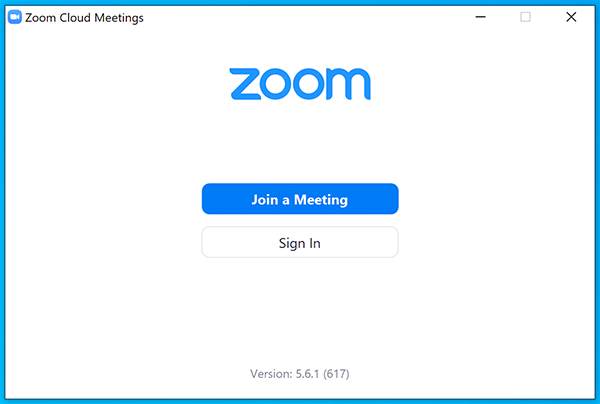
Click on "Join Webinar" at the top of this screen, enter your exact first and last name as you registered and enter the number of people attending at your location (including yourself). You should then be taken to the Zoom meeting room. Join with Zoom Application: For those joining with the Zoom application, you may be prompted to sign with a zoom account or join as a guest without signing in.
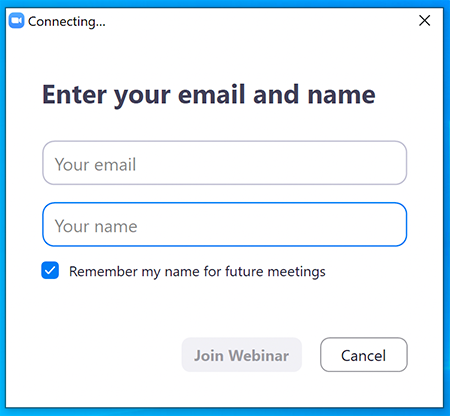
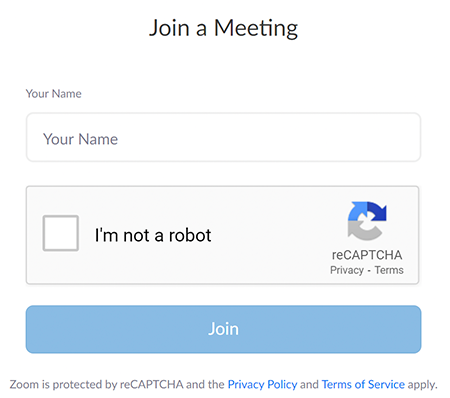
If joining as a guest, you will be prompted to enter your name and email address. Remember your name, image, video or voice may be visible to others in the live event. When done, click "Join" When it is time for the live event to start, the meeting host will admit you to the live Zoom meeting. Join via web browser (without the Zoom Application): For those joining with a web browser, you may close any pop ups prompting you to download the Zoom app. The next window will allow you to enter your name (first name and last name) and check the box that you are not a robot. Click the blue join button. You may also be asked to provide your email address before joining the room. Remember your name, image, video or voice may be visible to others in the live event. When done, click "Join" When it is time for the live event to start, the meeting host will admit you to the live Zoom meeting. You may need to periodically refresh the browser window to confirm if the host has admitted you. The presenters will control what slide you are viewing. You may submit questions online for the instructors to answer during the webinar by typing in the "Q&A" area. It is not necessary to wait until the question and answer periods to submit questions. At the end of the webinar you will be guided to our feedback form and links to additional resources, including the complete presentation. These links will remain active after the webinar. Provided for your convenience. Importing or accepting the invitation within this iCalendar file is not required, and declining the invitation does not cancel your registration. For additional information on iCalendar, please see our
iCalendar Help It is EPA's policy to make reasonable accommodation to persons with disabilities wishing to participate in the agency's programs and activities, pursuant to the Rehabilitation Act of 1973, 29 U.S.C. 791. Any request for accommodation should be made to Maura Cavagnaro at 202-715-3859 or maura.cavagnaro@nih.gov, preferably one week or more in advance of the webinar, so that EPA will have sufficient time to process the request. EPA would welcome specific recommendations from requestors specifying the nature or type of accommodation needed. EPA welcomes specific recommendations from requestors specifying the nature or type of accommodation needed. Please note that CLU-IN provides both alternate phone call-in options and closed captioning for all webinars, and requests for these specific accommodations are not necessary.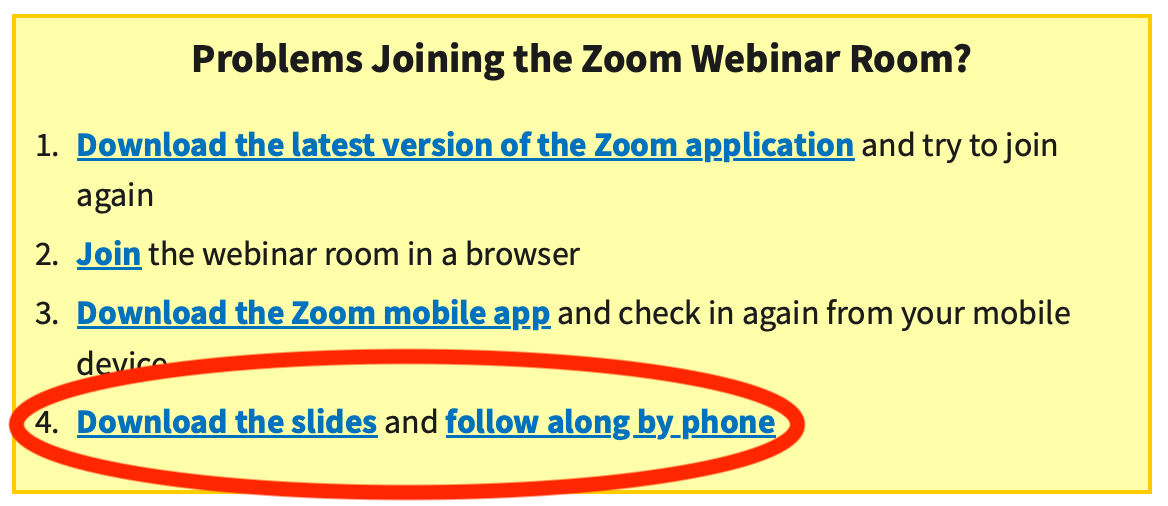
Webinar Day, Checking In
Moving Through Slides
Feedback & Links to Additional Resources
iCalendar File
Rehabilitation Act Notice for Reasonable Accommodation
Rehabilitation Act Notice for Reasonable Accommodation
It is EPA's policy to make reasonable accommodation to persons with disabilities wishing to participate in the agency's programs and activities, pursuant to the Rehabilitation Act of 1973, 29 U.S.C. 791. Any request for accommodation should be made to Maura Cavagnaro at 202-715-3859 or maura.cavagnaro@nih.gov, preferably one week or more in advance of the webinar, so that EPA will have sufficient time to process the request. EPA would welcome specific recommendations from requestors specifying the nature or type of accommodation needed. EPA welcomes specific recommendations from requestors specifying the nature or type of accommodation needed. Please note that CLU-IN provides both alternate phone call-in options and closed captioning for all webinars, and requests for these specific accommodations are not necessary.
Webinar Recording
By participating in this CLU-IN webinar, you automatically agree to authorize recording of audio and visual content presented during this live event and consent to subsequent use of this recording in the public domain by the U.S. Environmental Protection Agency. This recording may include questions, comments and poll responses provided by you during the live event in addition to your name, voice, image or likeness. This recording will be made available after the conclusion of the live event as part of the CLU-IN webinar archives, and will remain available indefinitely. If you do not wish to consent to the recording, please do not join the live event, and contact Jean Balent at 202-566-0832 or balent.jean@epa.gov to discuss your concerns.
Content Disclaimer
This webinar is intended solely to provide information to the public. The views and opinions expressed as part of this webinar do not necessarily state or reflect those of the U.S. Environmental Protection Agency. It is not intended, nor can it be relied upon, to create any rights enforceable by any party in litigation with the United States, or to endorse the use of products or services provided by specific vendors. With respect to this webinar, neither the United States Government nor any of their employees, makes any warranty, express or implied, including the warranties of merchantability and fitness for a particular purpose, or assumes any legal liability or responsibility for the accuracy, completeness, or usefulness of any information, apparatus, product, or process disclosed, or represents that its use would not infringe privately owned rights.